Bounce rate and suppression
A bounce is a rejection by the receiving mail server. It is the clearest signal you get about list quality, and it is the number that decides whether your mail keeps arriving: mailbox providers watch bounce rates to judge whether a sender is careless, and a careless sender gets filtered long before anyone tells them.
Your bounce rate is bounces divided by everything you sent in the window.
Where you see it
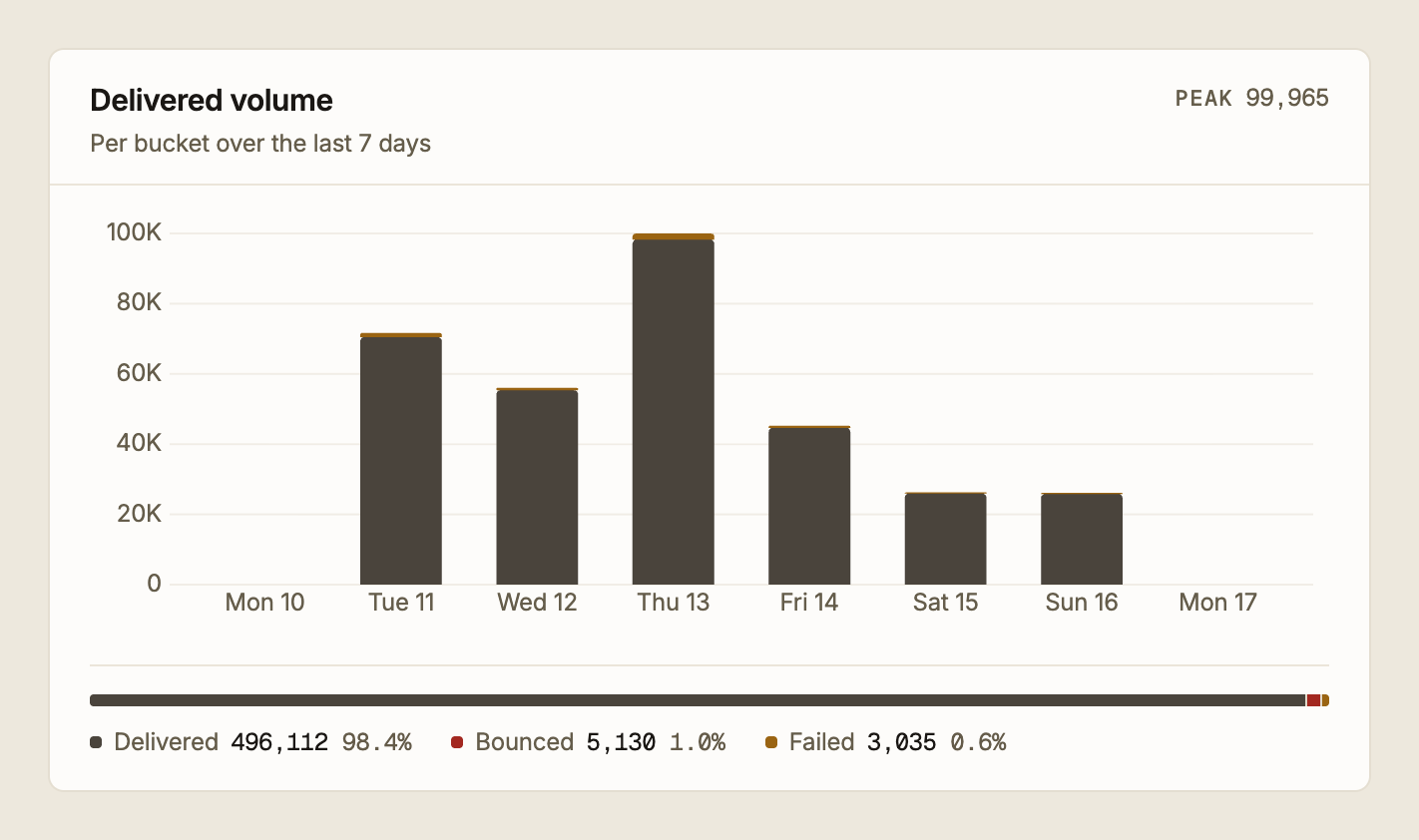
Overview shows it three ways: as one of the four measures, as the red segment under Delivered volume, and per domain in the Sending domains table.
A bounce records a rejection or non-delivery report from a receiving server. The email can
also have a failed status. Do not add raw failed and bounced counts as if they were disjoint.
Use the message timeline to distinguish a recipient rejection from another sending error.
See analytics for how API counts are measured.
The thresholds
Epostix flags a domain at two levels.
| Bounce rate | What happens |
|---|---|
| Under 2% | No bounce-rate warning at this threshold; inspect unexpected bounces anyway |
| 2% or higher | The domain is marked Bounce rate high and the figure turns amber |
| 5% or higher | The domain is marked Bouncing heavily, the figure turns red, and it is raised in the attention band at the top of Overview |
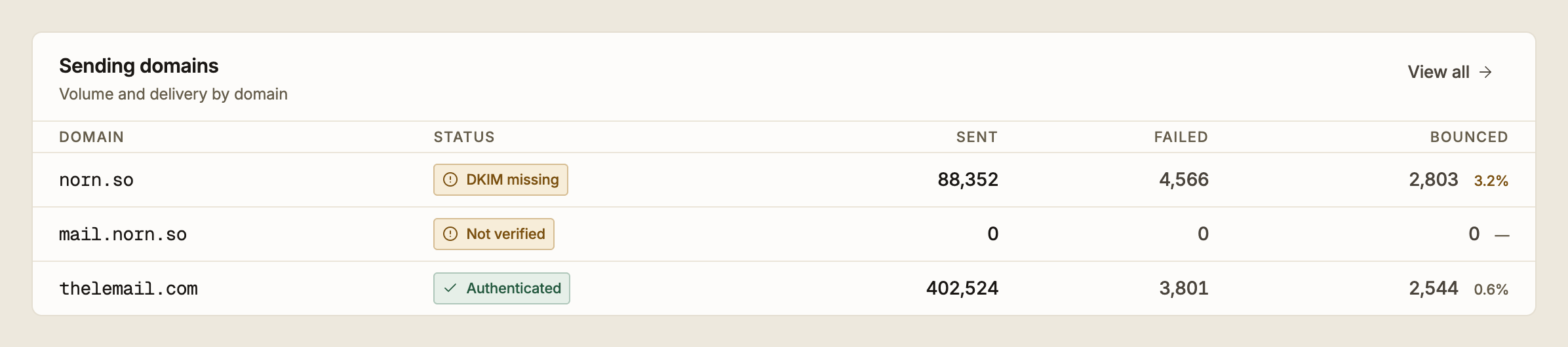
These thresholds are per domain, not per workspace. One bad domain is flagged on its own even when your overall rate looks healthy. That is the point, because reputation is tracked per domain.
Hard, soft, and infrastructure
Not every bounce means the same thing.
| Kind | Meaning | Example |
|---|---|---|
| Hard | The address does not exist and will not start existing | Unknown mailbox, bad destination domain, account disabled |
| Soft | The address exists but could not take the message now | Mailbox full, message too large, mailing-list expansion problem |
| Infrastructure | The rejection was about policy or transport, not the recipient | Encryption required, authentication rejected, message integrity failure |
Hard bounces are the ones that damage reputation. A high hard-bounce rate says you are mailing addresses you never confirmed.
What Epostix does automatically
You do not have to prune your list by hand. Bounces suppress addresses on their own.
A hard bounce suppresses the address permanently, on the first occurrence. There is no tolerance here, because a second attempt at an address that does not exist is the exact behaviour providers penalise.
A soft bounce is tolerated, then escalates. One on its own changes nothing, because a full mailbox or a server having a bad morning is not your fault. An address that keeps failing is suppressed temporarily, and one that is still failing after that becomes permanent.
While an address is temporarily suppressed it cannot escalate further, so a single bad week does not push a recoverable address to permanent.
The counts and the windows behind this are tuned as sending conditions change, so treat the behaviour as described here rather than as fixed numbers to plan around.
Suppression is per address, not per campaign. Once an address is suppressed, nothing you send reaches it until the suppression lifts, including transactional mail.
When the rate is high
Work down this list in order.
- Check which domain. The Sending domains table attributes bounces per domain. A workspace-wide rate hides the fact that one domain is usually responsible.
- Check what changed. The Delivered volume chart shows bounces per day. A rate that jumped on one day is a bad import or a single campaign; a rate that climbed steadily is list decay.
- Check the domain is still authenticated. A domain whose SPF or DKIM record has stopped resolving will bounce at providers that reject unauthenticated mail. Its DNS health panel says so directly.
- Stop sending to unconfirmed addresses. Purchased, scraped, or years-old lists are the usual cause. Nothing in the platform can repair a list that was never opt-in.
Bounce rate responds slowly. Once providers have judged a domain, cleaning the list stops the damage but does not immediately undo it. Recovery is measured in weeks of clean sending, which is the strongest argument for keeping the rate low while it already is.